May 9, 2026
The Köhler Effect: Why the Weak Link Tries Harder
Social loafing makes people slack off in groups. The Köhler effect is its opposite: being the weaker member can make you push harder, not less.
You are the slowest one in the group. The others clipped in ahead of you, and on paper that should sap you: you are the anchor, the one holding the pace down. So it is strange to notice what your legs are actually doing. You are not easing off. You are pushing harder than you ever do alone, chasing a wheel you cannot quite catch, and the session that would have ended twenty minutes ago is still going.
Most of us assume groups make individuals lazier. Put someone on a team and they lean on everyone else, do a little less, let the crowd carry the load. That instinct has a name and more than a century of evidence behind it. But there is a second, quieter pattern that runs the other way, and it shows up precisely when you are the one at the back.
A Gain, Not a Drain
The lazy-in-groups instinct is real. Researchers call it social loafing, or the Ringelmann effect after the agronomist who measured men pulling a rope together and found each one pulled less hard than they had alone. Add people, subtract individual effort. It is one of the sturdier findings in social psychology, and it is why group projects earned their reputation.
The Köhler effect is the mirror image. Kerr and Hertel describe it as a motivation gain: a weaker group member performing a difficult task better in a group than their solo performance would predict. Erich Witte, who revived the research in the late 1980s, called it the anti-Ringelmann effect, and the label fits. Same ingredient, other people, opposite result. In one structure the group drags you down. In another it lifts you up. The whole question is which structure you are standing in.
A Berlin Rowing Club and a Heavy Bar
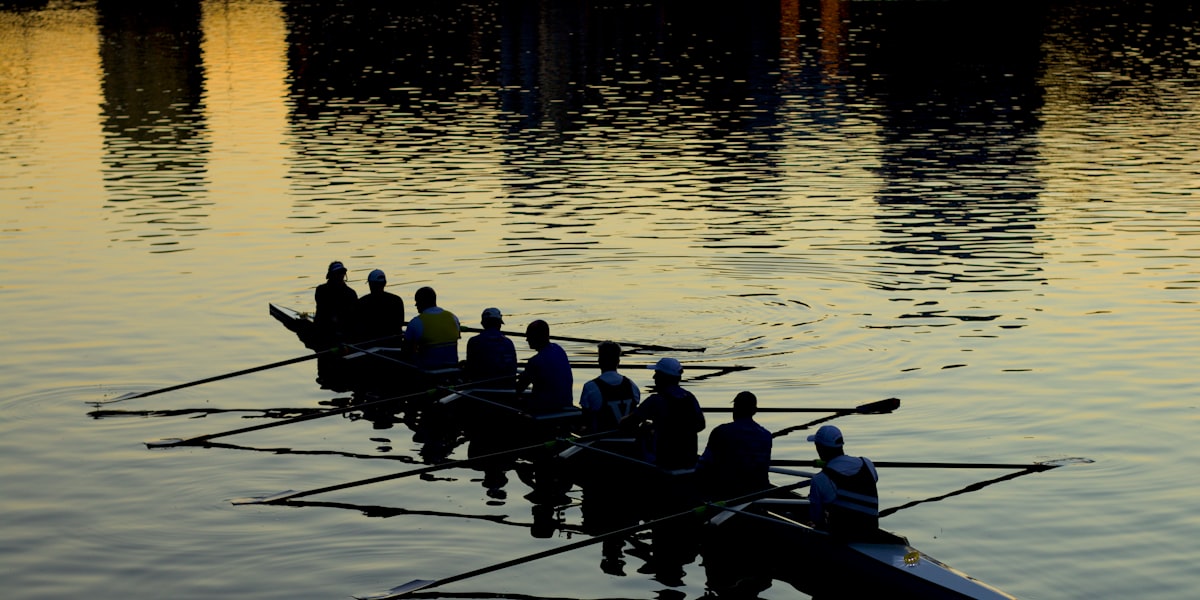
The effect is named for Otto Köhler, who ran the first controlled demonstrations in the 1920s with members of a Berlin rowing club. The task was brutally plain: hold a heavy bar and curl it, arms working, until you could not anymore. Sometimes a rower did it alone. Sometimes two or three did it together, holding a single bar loaded to match the group, so that the moment any one of them quit, the whole effort stopped.
That last detail is the hinge. Because the group could keep going only as long as its weakest member kept going, each person's effort genuinely decided the outcome. And what Köhler found, as Kerr and Hertel recount it, is that the crews held on longer than the weakest rower had ever managed by himself. The weak link did not sink to his solo limit. He climbed above it.
There was a catch, and it turns out to matter. The gain was largest when the rowers differed moderately in strength. Too evenly matched, and there was nothing to reach for. Too mismatched, and catching up felt hopeless, so the weaker one gave up rather than chase. The sweet spot was a gap you could believe in closing.
The weak link did not sink to his solo limit. Working where his effort decided the group's, he climbed above it.
Why the Weak Link Pulls Harder
Kerr and Hertel trace the gain to two mechanisms working together. The first is upward social comparison. Paired with someone more capable, the weaker member has a target moving just ahead, and the natural pull is to close the distance rather than let it stretch. The second is indispensability. When the group's result depends on your effort, quitting is not a private failure you can quietly absorb. It ends everyone's attempt. Your contribution is not decorative. It is load-bearing.
Either mechanism alone does something. Together they do the most work, which is why the effect is strongest in what researchers call conjunctive tasks: jobs where the group is only as good as its weakest performer. Hold the bar, and the person who drops first sets the limit for all of you. In that structure the weakest member is at once behind a better partner and holding the outcome in their hands. Both levers pull at the same time.
Twice as Long on a Bike
You do not have to take the rowing club on faith. Irwin and colleagues put the effect on a stationary bike. Fifty-eight young women, average age about twenty, pedaled at a set intensity across six separate days, and the thing being measured was simply how long they kept going before they stopped.
Some rode alone. Some rode alongside another person but were scored independently, company without a shared fate. And some were placed in a conjunctive setup: paired with a partner who was, as far as they knew, a little more capable, where the team's performance was decided by whoever gave up first. That last group was the weak link by design, and their effort was the one that counted.
The gap was not subtle.
In Irwin and colleagues' study, women whose effort counted toward a team persisted about 21.89 minutes on the bike, versus about 10.6 minutes riding alone - roughly double (Irwin et al., 2012).
Riding alone, the women lasted around eleven minutes. In the conjunctive condition, where they were the indispensable weak link, they lasted close to twenty-two. Two details are worth holding onto. The partner was virtual, present only on a screen, and the boost appeared anyway. And the number measures persistence, how long they pushed, not fitness or weight or any health outcome. What moved was effort.
Company Helps. Counting Helps More.
The middle group is the interesting one. Women who merely rode alongside a partner, with no shared outcome, still lasted about twenty minutes, well past the solo eleven. Plain company did a great deal. But the conjunctive riders, the ones whose effort decided the team's result, went furthest of all, significantly past even the people with company.
Read carefully, that is two lessons rather than one. Being around others chasing the same thing lifts effort by itself. And making your effort matter to those others tends to lift it further. I say tends, because this is not an iron law. The same lab tested the idea with isometric plank holds and found the partnered exercisers held on longer than solo ones, yet the conjunctive structure there was no more motivating than simply having company. The pattern across the research is that the weak-link setup is the strongest lever, not that it wins in every single case.
Not the Same as Comparing Yourself
It is tempting to file this under comparison and move on, but the Köhler effect is a narrower thing than comparing yourself to others. General social comparison is closer to a coin toss: seeing someone ahead can light a fire or quietly convince you that you do not belong. What tips it toward fire here is the second ingredient. Your effort is not merely being weighed against a better performer. It is deciding a shared outcome. The comparison has a job to do.
It is also not quite the shared goals effect, where simply knowing that people like you want the same thing sharpens your pursuit with no interaction and no shared stakes at all. The Köhler effect asks for more. Your effort has to actually count toward a group result. That is a heavier structure, and it produces a particular kind of push, the reach of the person who knows the team is only as strong as they are right now.
Building the Structure on Purpose
You cannot always be the weak link, and you would not want to be. But you can notice that the setups quietly draining you and the ones quietly lifting you differ in a way you can name, and you can choose more of the second.
The ingredients are portable. Put yourself around people a step ahead of where you are, close enough that the gap looks crossable. Then arrange things so that your showing up registers to someone other than you, so going quiet is not a private non-event but something a person notices. A training partner who waits for you. A group whose weekly total counts your miles. A community where your streak is visible and your absence is too. None of it requires being the best in the room. The Köhler effect is the rare piece of motivation research that rewards being a little behind, as long as your effort counts.
There is a design lesson buried in the moderate-gap finding too. If the people around you are so far ahead that catching up feels absurd, the pull inverts and you slacken, the same way Köhler's badly mismatched pairs did. So the aim is not the most impressive room you can find. It is a room where the person just ahead is running a pace you could imagine holding on a good day. Reachable, not mythical.
None of this is about pressure for its own sake, and it is not accountability in the guilt sense either. Nobody has to scold you. The effect runs on something calmer: the plain fact that your effort matters to more than you, and that someone a little better is close enough to chase. Put those two facts in the same place and the pull takes care of itself.
That structure is most of what a good accountability app is for. Future You puts capable people in view and makes your effort matter to more than just you: a community that sees your progress, so showing up is something others register and going quiet is something they notice. It is the setup the Köhler effect runs on, minus the treadmill, and it is free on iOS and Android.
Sources
- Kerr, N. L. & Hertel, G. (2011). The Köhler Group Motivation Gain: How to Motivate the 'Weak Links' in a Group. Social and Personality Psychology Compass, 5(1), 43-55. DOI
- Irwin, B. C., Scorniaenchi, J., Kerr, N. L., Eisenmann, J. C. & Feltz, D. L. (2012). Aerobic Exercise Is Promoted when Individual Performance Affects the Group: A Test of the Kohler Motivation Gain Effect. Annals of Behavioral Medicine, 44(2), 151-159. DOI
- Witte, E. H. (1989). Köhler rediscovered: The anti-Ringelmann effect. European Journal of Social Psychology, 19(2), 147-154. DOI
Ready to start?
Free on iOS and Android. Your first goal takes 60 seconds.